Data Format
Table of contents
- Event Objects
- From Raw Signals to Tracks
- Raw Signal Events
- Detector Signal Events
- Detector Hit Events
- Track Events
- Analysis Observables
- Which Event Type Is in My File?
- Where to Go Next
REST stores data in ROOT files. A REST file usually contains three kinds of information:
- Metadata, describing the run, detector configuration, readout, gas, geometry, analysis parameters, and processing chain.
- Event data, stored as objects derived from
TRestEvent. - Analysis observables, stored in a
TRestAnalysisTreeand used for selections, plotting, and higher-level analysis.
This page gives a first map of the event data model. It is meant as an orientation guide for new users; for the full list of methods of each class, use the class reference.
Event Objects
All REST event classes inherit from TRestEvent. Each event object represents one entry in the event tree, but the physical meaning of the entry depends on the concrete event class. For example, an event may contain raw electronics waveforms, detector-channel signals, spatial hits, or reconstructed tracks.
The most common event representations in a detector-analysis chain are:
These classes do not replace one another arbitrarily. They represent different levels of reconstruction.
From Raw Signals to Tracks
For data acquired from electronics, the usual conceptual flow is:
DAQ data
  -> TRestRawSignalEvent
  -> TRestDetectorSignalEvent
  -> TRestDetectorHitsEvent
  -> TRestTrackEvent
  -> analysis observables
For simulations, the chain often starts from generated or simulated particles and then moves toward detector response:
TRestGeant4Event
  -> TRestDetectorHitsEvent
  -> TRestDetectorSignalEvent
  -> TRestRawSignalEvent
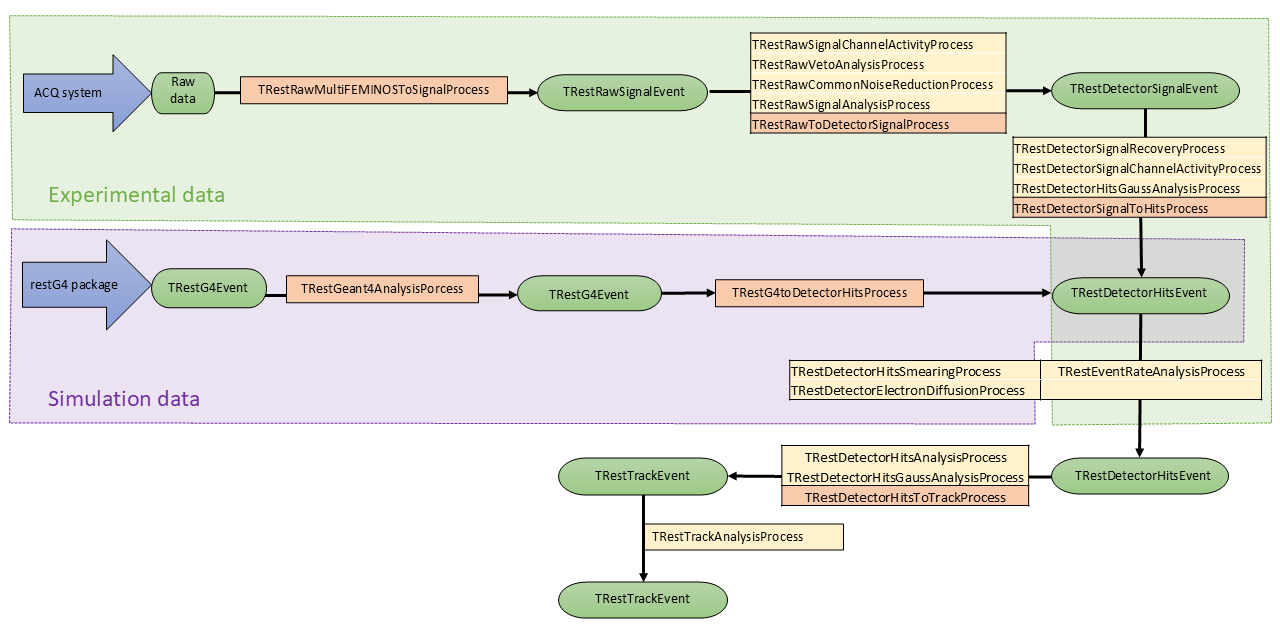
The next figure shows how experimental data and simulated data enter related REST processing chains. Experimental data usually start from raw DAQ data and are converted into raw signal events and detector signal events. Simulations usually start from restG4 events and enter the detector chain at the hit-event level. From there, both paths can use common detector-hit, track, and analysis processes.
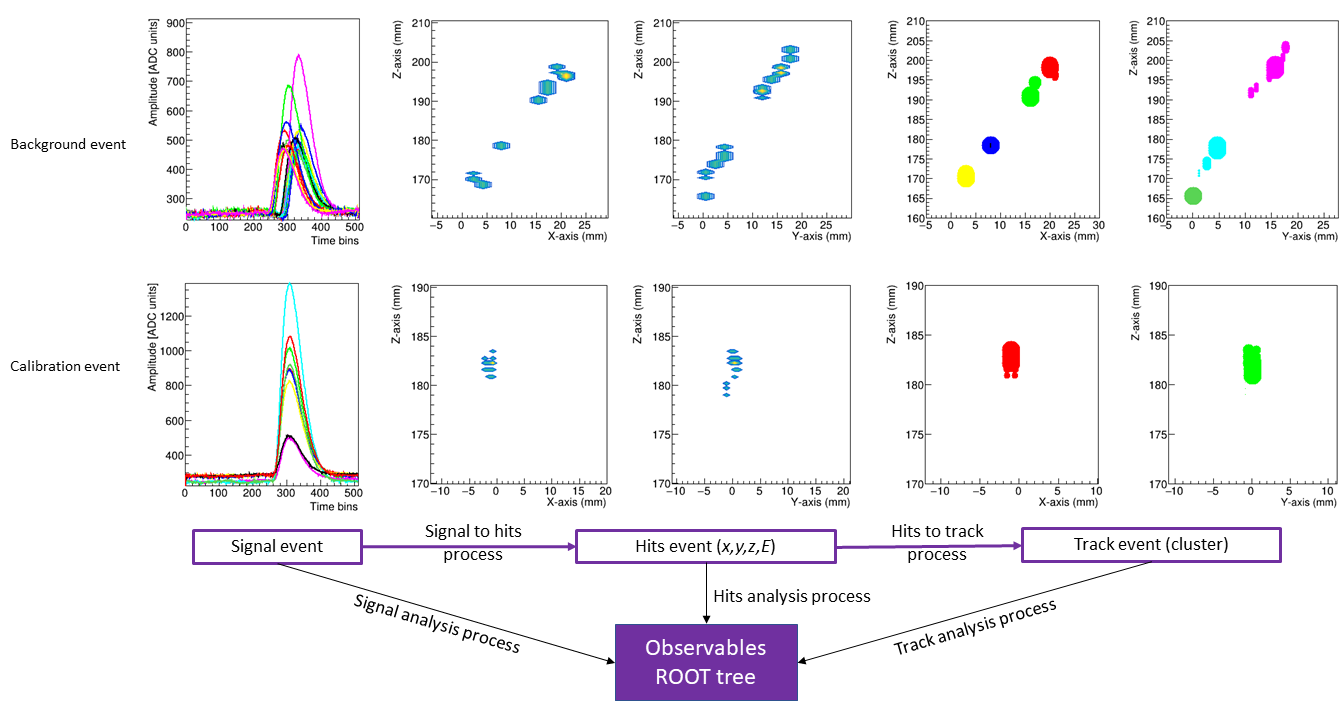
The following figure shows a Micromegas example of this event evolution. The same processing steps are applied to a background event and to a calibration event: signal events are transformed into hit events, hit events can be clustered into track events, and analysis processes write observables into a ROOT tree.
Raw Signal Events
TRestRawSignalEvent stores digitized raw waveforms. It is a collection of TRestRawSignal objects, where each signal normally corresponds to one electronics or readout channel.
Each TRestRawSignal stores ADC-like samples indexed by time bin. This is the representation closest to the DAQ waveform and is the natural place for baseline correction, threshold finding, raw pulse-shape observables, and channel-level waveform inspection.
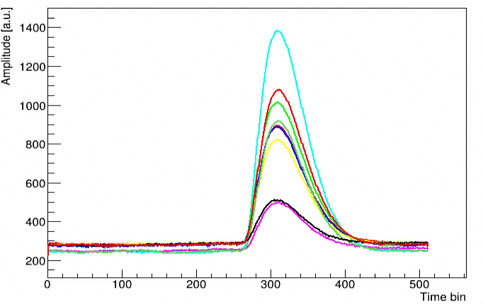
Use this representation when the analysis depends on ADC samples, time bins, baseline windows, thresholds, or raw waveform shape.
Detector Signal Events
TRestDetectorSignalEvent stores detector-channel signals in physical coordinates. It is a collection of TRestDetectorSignal objects, where each signal stores time-charge points rather than a fixed ADC-bin array.
This representation is used after raw data have been converted into detector signals, or after simulated detector hits have been projected onto a readout. The time axis is expressed in physical units, typically microseconds, and the signal ID identifies the corresponding detector or readout channel.
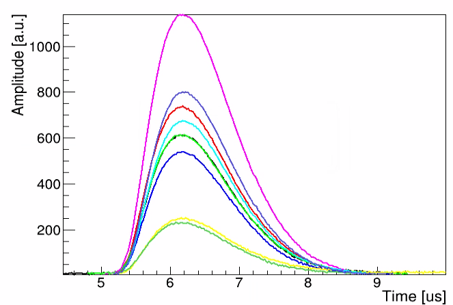
Use this representation when the analysis needs channel signals expressed in physical time, or when converting between readout-channel information and spatial detector hits.
Detector Hit Events
TRestDetectorHitsEvent stores spatial hits in detector coordinates. A hit represents a localized energy deposit or reconstructed point in the detector. Compared with signal events, hit events no longer describe channel waveforms; they describe positions and energies.
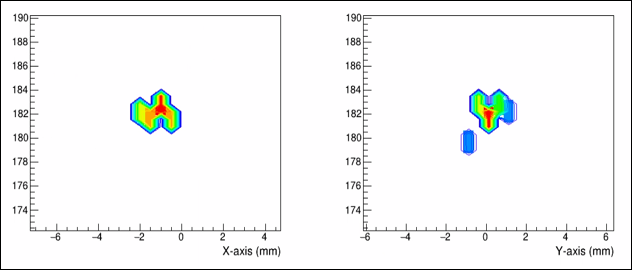
Use this representation for hit maps, spatial selections, fiducialization, topology variables, and reconstruction steps that operate on positions rather than electronics channels.
Track Events
TRestTrackEvent stores reconstructed track information. Track events are built from hits and organize them into higher-level structures that describe event topology.
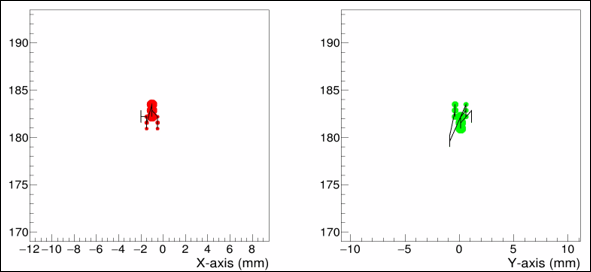
Use this representation when the analysis needs track observables, such as cluster or topology variables, rather than individual waveform or hit-level quantities.
Analysis Observables
Event objects store the detailed event representation. Analysis observables are the quantities extracted from those events and written to a TRestAnalysisTree. They are usually simpler values such as energies, integrals, amplitudes, times, positions, number of hits, or selection flags.
In practice, most plotting and event selection is done with the analysis tree, while event objects are used when the analysis needs to inspect or transform the event content itself.
Which Event Type Is in My File?
When opening a REST file, the first practical question is often: which event class does this file contain?
In restRoot, a quick check is:
TRestRun run("myFile.root");
std::cout << run.GetInputEvent()->ClassName() << std::endl;
Once the event type is known, retrieve it with the corresponding class:
TRestRun run("myFile.root");
run.GetEntry(0);

auto event = run.GetInputEvent<TRestRawSignalEvent>();
event->DrawEvent();
Replace TRestRawSignalEvent with the event class stored in your file, for example TRestDetectorSignalEvent, TRestDetectorHitsEvent, or TRestTrackEvent.