 |
REST-for-Physics
v2.3
Rare Event Searches ToolKit for Physics
|
Loading...
Searching...
No Matches
|
REST-for-Physics
v2.3
Rare Event Searches ToolKit for Physics
|
An analysis process to extract valuable information from a TRestRawSignalEvent.
THIS DOCUMENTATION NEEDS REVISION. TODO If possible a figure with the pulse ilustrating the different observables extracted.
The following metadata parameters might be defined at the RML to control the rawsignal analysis is performed:
There are 3 additional parameters that are used in combination to identify the points over threshold at each signal. Those parameters are used, for example, to calculate the number of good signals observable.
Additionaly, there is a metadata parameter,signalsRange that allows to define the signal ids over which this process will have effect. This parameter may allow to define different TRestRawSignalAnalysisProcess instances at the RML operating over different signal ranges. For example:
Number of signals and base line:
Integrals and energy estimations:
Time observables:
Peak amplitude observables:
Peak time observables:
Observables for individual signal info:
You may add filters to any observable inside the analysis tree. To add a cut, write "cut" sections in your rml file:
RESTsoft - Software for Rare Event Searches with TPCs
History of developments:
2017-February: First implementation of raw signal analysis process into REST_v2. Created from TRestDetectorSignalAnalysisProcess
Definition at line 31 of file TRestRawSignalAnalysisProcess.h.
#include <TRestRawSignalAnalysisProcess.h>
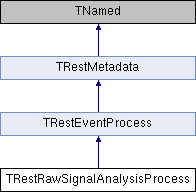
Public Member Functions | |
| ClassDefOverride (TRestRawSignalAnalysisProcess, 5) | |
| RESTValue | GetInputEvent () const override |
| Get pointer to input event. Must be implemented in the derived class. | |
| RESTValue | GetOutputEvent () const override |
| Get pointer to output event. Must be implemented in the derived class. | |
| const char * | GetProcessName () const override |
| void | InitFromConfigFile () override |
| To make settings from rml file. This method must be implemented in the derived class. | |
| void | InitProcess () override |
| Process initialization. | |
| void | PrintMetadata () override |
| Implemented it in the derived metadata class to print out specific metadata information. | |
| TRestEvent * | ProcessEvent (TRestEvent *inputEvent) override |
| The main processing event function. | |
| TRestRawSignalAnalysisProcess () | |
| Default constructor. | |
| ~TRestRawSignalAnalysisProcess () | |
| Default destructor. | |
| Public Member Functions inherited from TRestEventProcess | |
| virtual Bool_t | AddInputFile (const std::string &file) |
| bool | ApplyCut () |
| Apply cut according to the cut conditions saved in fCut. | |
| virtual void | BeginOfEventProcess (TRestEvent *inputEvent=nullptr) |
| Begin of event process, preparation work. Called right before ProcessEvent(). | |
| ClassDefOverride (TRestEventProcess, 3) | |
| virtual void | EndOfEventProcess (TRestEvent *inputEvent=nullptr) |
| End of event process. Nothing to do. Called directly after ProcessEvent(). | |
| virtual void | EndProcess () |
| To be executed at the end of the run (outside event loop). | |
| TRestAnalysisTree * | GetAnalysisTree () const |
| Return the local analysis tree (dummy). | |
| TCanvas * | GetCanvas () const |
| Get canvas. | |
| TRestAnalysisTree * | GetFullAnalysisTree () |
| Get the full analysis tree from TRestRun, with non-empty entries. | |
| std::vector< std::string > | GetListOfAddedObservables () |
| Get list of observables, convert map to vector. | |
| TRestRun * | GetRunInfo () const |
| Return the pointer of the hosting TRestRun object. | |
| virtual Long64_t | GetTotalBytes () const |
| virtual Long64_t | GetTotalBytesRead () const |
| Interface to external file reading, get the read bytes. To be implemented in external processes. | |
| Bool_t | isExternal () const |
| Return whether this process is external process. | |
| Int_t | LoadSectionMetadata () override |
| Load extra section metadata: outputlevel after calling TRestMetadata::LoadSectionMetadata(). | |
| virtual void | NotifyAnalysisTreeReset () |
| In case the analysis tree is reset(switched to new file), some process needs to have action. | |
| virtual Bool_t | OpenInputFiles (const std::vector< std::string > &files) |
| Interface to external file reading, open input file. To be implemented in external processes. | |
| std::vector< std::string > | ReadObservables () |
| void | RegisterAllObservables (Bool_t value=true) |
| virtual Bool_t | ResetEntry () |
| void | SetAnalysisTree (TRestAnalysisTree *tree) |
| Set analysis tree of this process, then add observables to it. | |
| void | SetCanvasSize (Int_t x, Int_t y) |
| Set canvas size. | |
| void | SetFriendProcess (TRestEventProcess *p) |
| Add friendly process to this process. | |
| void | SetObservableValidation (bool validate) |
| void | SetParallelProcess (TRestEventProcess *p) |
| Add parallel process to this process. | |
| void | SetRunInfo (TRestRun *r) |
| Set TRestRun for this process. | |
| Bool_t | singleThreadOnly () const |
| Return whether this process is single std::thread only. | |
| TRestEventProcess () | |
| ~TRestEventProcess () | |
| Public Member Functions inherited from TRestMetadata | |
| void | AddLog (std::string log="", bool print=true) |
| Add logs to messageBuffer. | |
| void | DoNotStore () |
| If this method is called the metadata information will not be stored in disk. | |
| TVector2 | Get2DVectorParameterWithUnits (std::string parName, TVector2 defaultValue=TVector2(-1, -1)) |
| TVector3 | Get3DVectorParameterWithUnits (std::string parName, TVector3 defaultValue=TVector3(-1, -1, -1)) |
| TString | GetCommit () |
| Returns the REST commit value stored in fCommit. | |
| std::string | GetConfigBuffer () |
| Returns the config section of this class. | |
| std::string | GetDataMemberValue (std::string memberName) |
| Get the value of data member as string. | |
| std::vector< std::string > | GetDataMemberValues (std::string memberName, Int_t precision=0) |
| Get the value of datamember as a vector of strings. | |
| TString | GetDataPath () |
| Returns a std::string with the path used for data storage. | |
| Double_t | GetDblParameterWithUnits (std::string parName, Double_t defaultValue=PARAMETER_NOT_FOUND_DBL) |
| Gets the value of the parameter name parName, after applying unit conversion. | |
| Bool_t | GetError () const |
| It returns true if an error was identified by a derived metadata class. | |
| TString | GetErrorMessage () |
| Returns a std::string containing the error message. | |
| TString | GetLibraryVersion () |
| Returns the REST libraty version stored in fLibraryVersion. | |
| TString | GetMainDataPath () |
| Gets a std::string with the path used for data storage. | |
| Int_t | GetNumberOfErrors () const |
| Int_t | GetNumberOfWarnings () const |
| std::string | GetParameter (std::string parName, TString defaultValue=PARAMETER_NOT_FOUND_STR) |
| Returns corresponding REST Metadata parameter from multiple sources. | |
| std::string | GetSectionName () |
| Returns the section name of this class, defined at the beginning of fSectionName. | |
| TRestStringOutput::REST_Verbose_Level | GetVerboseLevel () |
| returns the verboselevel in type of REST_Verbose_Level enumerator | |
| TString | GetVerboseLevelString () |
| returns the verbose level in type of TString | |
| TString | GetVersion () |
| Returns the REST version stored in fVersion. | |
| Int_t | GetVersionCode () |
| UInt_t | GetVersionMajor () const |
| UInt_t | GetVersionMinor () const |
| UInt_t | GetVersionPatch () const |
| Bool_t | GetWarning () const |
| It returns true if an error was identified by a derived metadata class. | |
| TString | GetWarningMessage () |
| Returns a std::string containing the warning message. | |
| TRestMetadata * | InstantiateChildMetadata (int index, std::string pattern="") |
| This method will retrieve a new TRestMetadata instance of a child element of the present TRestMetadata instance based on the index given by argument, which defines the element order to be retrieved, 0 for first element found, 1 for the second element found, etc. | |
| TRestMetadata * | InstantiateChildMetadata (std::string pattern="", std::string name="") |
| This method will retrieve a new TRestMetadata instance of a child element of the present TRestMetadata instance based on the name given by argument. | |
| Bool_t | isCleanState () const |
| Bool_t | isOfficialRelease () const |
| Int_t | LoadConfigFromBuffer () |
| Initialize data from a string element buffer. | |
| Int_t | LoadConfigFromElement (TiXmlElement *eSectional, TiXmlElement *eGlobal, std::map< std::string, std::string > envs={}) |
| Main starter method. | |
| Int_t | LoadConfigFromFile (const std::string &configFilename, const std::string §ionName="") |
| Give the file name, find out the corresponding section. Then call the main starter. | |
| virtual void | Merge (const TRestMetadata &) |
| TRestMetadata & | operator= (const TRestMetadata &) |
| void | Print () |
| Implementing TObject::Print() method. | |
| void | PrintConfigBuffer () |
| Print the config xml section stored in the class. | |
| void | PrintMessageBuffer () |
| Print the buffered message. | |
| void | PrintTimeStamp (Double_t timeStamp) |
| Print the current time on local machine. | |
| void | SetConfigFile (std::string configFilename) |
| set config file path from external | |
| void | SetError (std::string message="", bool print=true, int maxPrint=5) |
| A metadata class may use this method to signal that something went wrong. | |
| void | SetHostmgr (TRestManager *m) |
| Set the host manager for this class. | |
| void | SetSectionName (std::string sName) |
| set the section name, clear the section content | |
| void | SetVerboseLevel (TRestStringOutput::REST_Verbose_Level v) |
| sets the verbose level | |
| void | SetWarning (std::string message="", bool print=true, int maxPrint=5) |
| A metadata class may use this method to signal that something went wrong. | |
| void | Store () |
| If this method is called the metadata information will be stored in disk. | |
| TRestMetadata (const TRestMetadata &) | |
| virtual void | UpdateMetadataMembers () |
| Method to allow implementation of specific metadata members updates at inherited classes. | |
| virtual Int_t | Write (const char *name=nullptr, Int_t option=0, Int_t bufsize=0) |
| overwriting the write() method with fStore considered | |
| void | WriteConfigBuffer (std::string fName) |
| Writes the config buffer to a file in append mode. | |
| ~TRestMetadata () | |
| TRestMetadata default destructor. | |
Private Member Functions | |
| void | Initialize () override |
| Function to initialize input/output event members and define the section name. | |
Private Attributes | |
| std::string | fBaseLineOption |
| Option for calculation of baseline parameters, can be set to "ROBUST". | |
| TVector2 | fBaseLineRange = TVector2(5, 55) |
| The range where the baseline range will be calculated. | |
| std::string | fChannelType |
| avoid error when loading parameters (not used) | |
| std::set< std::string > | fChannelTypes = {} |
| TVector2 | fIntegralRange = TVector2(10, 500) |
| The range where the observables will be calculated. | |
| Int_t | fPointsOverThreshold = 5 |
| The minimum number of points over threshold to identify a signal as such. | |
| Double_t | fPointThreshold = 2 |
| The number of sigmas over baseline fluctuations to identify a point over threshold. | |
| Bool_t | fRangeEnabled = false |
| Just a flag to quickly determine if we have to apply the range filter. | |
| TRestRawReadoutMetadata * | fReadoutMetadata = nullptr |
| TRestRawSignalEvent * | fSignalEvent |
| A pointer to the specific TRestRawSignalEvent input. | |
| TVector2 | fSignalsRange = TVector2(-1, -1) |
| It defines the signals id range where analysis is applied. | |
| Double_t | fSignalThreshold = 5 |
| A parameter to define a minimum signal fluctuation. Measured in sigmas. | |
Additional Inherited Members | |
| Protected Types inherited from TRestEventProcess | |
| enum | REST_Process_Output { No_Output , Observable , Internal_Var , Full_Output } |
| Protected Member Functions inherited from TRestEventProcess | |
| void | BeginPrintProcess () |
| [name, cut range] | |
| void | CreateCanvas () |
| Create the canvas. | |
| void | EndPrintProcess () |
| Pre-defined printer, can be used at the ending in the implementation of PrintMetadata(). | |
| TRestEventProcess * | GetFriend (const std::string &nameOrType) |
| Get friendly TRestEventProcess object. | |
| TRestEventProcess * | GetFriendLive (const std::string &nameOrType) |
| Get friendly TRestEventProcess object. | |
| template<class T> | |
| T * | GetMetadata () |
| Get a metadata object from the host TRestRun. | |
| TRestMetadata * | GetMetadata (const std::string &nameOrType) |
| Get a metadata object from the host TRestRun. | |
| size_t | GetNumberOfParallelProcesses () const |
| template<class T> | |
| T | GetObservableValue (const std::string &name) |
| TRestEventProcess * | GetParallel (int i) |
| Get a list of parallel processes from this process. | |
| template<class T> | |
| std::vector< T > | GetParallelDataMembers (T *member_of_process) |
| Get a list of data members from parallel processes which is same to this process's certain data member. | |
| template<class T> | |
| void | SetObservableValue (const std::string &name, const T &value) |
| Set observable value for AnalysisTree. | |
| Protected Member Functions inherited from TRestMetadata | |
| std::string | ElementToString (TiXmlElement *ele) |
| Convert an TiXmlElement object to string. | |
| TVector2 | Get2DVectorParameterWithUnits (std::string parName, TiXmlElement *e, TVector2 defaultValue=TVector2(-1, -1)) |
| TVector3 | Get3DVectorParameterWithUnits (std::string parName, TiXmlElement *e, TVector3 defaultValue=TVector3(-1, -1, -1)) |
| Double_t | GetDblParameterWithUnits (std::string parName, TiXmlElement *e, Double_t defaultVal=PARAMETER_NOT_FOUND_DBL) |
| TiXmlElement * | GetElement (std::string eleDeclare, TiXmlElement *e=nullptr) |
| Get an xml element from a given parent element, according to its declaration. | |
| TiXmlElement * | GetElementFromFile (std::string configFilename, std::string NameOrDecalre="") |
| Open an xml encoded file and find its element. | |
| TiXmlElement * | GetElementWithName (std::string eleDeclare, std::string eleName) |
| Get an xml element from the default location, according to its declaration and its field "name". | |
| TiXmlElement * | GetElementWithName (std::string eleDeclare, std::string eleName, TiXmlElement *e) |
| Get an xml element from a given parent element, according to its declaration and its field "name". | |
| std::string | GetFieldValue (std::string fieldName, std::string definition, size_t fromPosition=0) |
| Gets field value in an xml element string by parsing it as TiXmlElement. | |
| std::string | GetFieldValue (std::string parName, TiXmlElement *e) |
| Returns the field value of an xml element which has the specified name. | |
| std::string | GetKEYDefinition (std::string keyName) |
| Gets the first key definition for keyName found inside buffer starting at fromPosition. | |
| std::string | GetKEYDefinition (std::string keyName, size_t &Position) |
| std::string | GetKEYDefinition (std::string keyName, size_t &Position, std::string buffer) |
| std::string | GetKEYDefinition (std::string keyName, std::string buffer) |
| std::string | GetKEYStructure (std::string keyName) |
| Gets the first key structure for keyName found inside buffer after fromPosition. | |
| std::string | GetKEYStructure (std::string keyName, size_t &Position) |
| std::string | GetKEYStructure (std::string keyName, size_t &Position, std::string buffer) |
| std::string | GetKEYStructure (std::string keyName, size_t &Position, TiXmlElement *ele) |
| std::string | GetKEYStructure (std::string keyName, std::string buffer) |
| TiXmlElement * | GetNextElement (TiXmlElement *e) |
| Get the next sibling xml element of this element, with same eleDeclare. | |
| std::string | GetParameter (std::string parName, size_t &pos, std::string inputString) |
| Returns the value for the parameter name parName found in inputString. | |
| std::string | GetParameter (std::string parName, TiXmlElement *e, TString defaultValue=PARAMETER_NOT_FOUND_STR) |
| Returns the value for the parameter named parName in the given section. | |
| std::pair< std::string, std::string > | GetParameterAndUnits (std::string parname, TiXmlElement *e=nullptr) |
| Returns the unit string of the given parameter of the given xml section. | |
| std::map< std::string, std::string > | GetParametersList () |
| It retrieves a map of all parameter:value found in the metadata class. | |
| TString | GetSearchPath () |
| virtual void | InitFromRootFile () |
| Method called after the object is retrieved from root file. | |
| void | ReadAllParameters () |
| Reflection methods, Set value of a datamember in class according to TRestMetadata::fElement. | |
| void | ReadParametersList (std::map< std::string, std::string > &list) |
| It reads a parameter list and associates it to its corresponding metadata member. par0 --> fPar0. | |
| std::string | ReplaceConstants (const std::string buffer) |
| Identifies "constants" in the input buffer, and replace them with corresponding value. | |
| std::string | ReplaceVariables (const std::string buffer) |
| Identifies environmental variable replacing marks in the input buffer, and replace them with corresponding value. | |
| void | ReSetVersion () |
| Resets the version of TRestRun to REST_RELEASE. Only TRestRun is allowed to update version. | |
| std::string | SearchFile (std::string filename) |
| Search files in current directory and directories specified in "searchPath" section. | |
| void | SetLibraryVersion (TString version) |
| Set the library version of this metadata class. | |
| TiXmlElement * | StringToElement (std::string definition) |
| Parsing a string into TiXmlElement object. | |
| TRestMetadata () | |
| TRestMetadata default constructor. | |
| TRestMetadata (const char *configFilename) | |
| constructor | |
| void | UnSetVersion () |
| Resets the version of TRestRun to -1, in case the file is old REST file. Only TRestRun is allowed to update version. | |
| Protected Attributes inherited from TRestEventProcess | |
| TRestAnalysisTree * | fAnalysisTree = nullptr |
| TCanvas * | fCanvas = nullptr |
| < Canvas for some viewer event | |
| TVector2 | fCanvasSize |
| Canvas size. | |
| std::vector< std::pair< std::string, TVector2 > > | fCuts |
| Stores cut definitions. Any listed observables should be in the range. | |
| bool | fDynamicObs = false |
| It defines whether to use added observables only or all the observables appear in the code. | |
| bool | fIsExternal = false |
| It defines if the process reads event data from an external source. | |
| std::map< std::string, int > | fObservablesDefined |
| Stores the list of all the appeared process observables in the code. | |
| std::map< std::string, int > | fObservablesUpdated |
| Stores the list of process observables updated when processing this event. | |
| bool | fReadOnly = false |
| not used, keep for compatibility | |
| TRestRun * | fRunInfo = nullptr |
| < Pointer to TRestRun object where to find metadata. | |
| bool | fSingleThreadOnly = false |
| bool | fValidateObservables = false |
| It defines if observable names should be added to the validation list. | |
| Protected Attributes inherited from TRestMetadata | |
| std::string | configBuffer |
| The buffer where the corresponding metadata section is stored. Filled only during Write(). | |
| std::string | fConfigFileName |
| Full name of the rml file. | |
| std::map< std::string, std::string > | fConstants |
| Saving a list of rml constants. name-value std::pair. Constants are temporary for this class only. | |
| TiXmlElement * | fElement |
| Saving the sectional element together with global element. | |
| TiXmlElement * | fElementGlobal |
| Saving the global element, to be passed to the resident class, if necessary. | |
| Bool_t | fError = false |
| It can be used as a way to identify that something went wrong using SetError method. | |
| TString | fErrorMessage = "" |
| A std::string to store an optional error message through method SetError. | |
| TRestManager * | fHostmgr |
| All metadata classes can be initialized and managed by TRestManager. | |
| Int_t | fNErrors = 0 |
| It counts the number of errors notified. | |
| Int_t | fNWarnings = 0 |
| It counts the number of warnings notified. | |
| std::string | fSectionName |
| Section name given in the constructor of the derived metadata class. | |
| Bool_t | fStore |
| This variable is used to determine if the metadata structure should be stored in the ROOT file. | |
| std::map< std::string, std::string > | fVariables |
| Saving a list of rml variables. name-value std::pair. | |
| TRestStringOutput::REST_Verbose_Level | fVerboseLevel |
| Verbose level used to print debug info. | |
| Bool_t | fWarning = false |
| It can be used as a way to identify that something went wrong using SetWarning method. | |
| TString | fWarningMessage = "" |
| It can be used as a way to identify that something went wrong using SetWarning method. | |
| std::string | messageBuffer |
| The buffer to store the output message through TRestStringOutput in this class. | |
| endl_t | RESTendl |
| Termination flag object for TRestStringOutput. | |
| TRestRawSignalAnalysisProcess::TRestRawSignalAnalysisProcess | ( | ) |
Default constructor.
Definition at line 259 of file TRestRawSignalAnalysisProcess.cxx.
| TRestRawSignalAnalysisProcess::~TRestRawSignalAnalysisProcess | ( | ) |
Default destructor.
Definition at line 264 of file TRestRawSignalAnalysisProcess.cxx.
|
inlineoverridevirtual |
Get pointer to input event. Must be implemented in the derived class.
Implements TRestEventProcess.
Definition at line 73 of file TRestRawSignalAnalysisProcess.h.
|
inlineoverridevirtual |
Get pointer to output event. Must be implemented in the derived class.
Implements TRestEventProcess.
Definition at line 75 of file TRestRawSignalAnalysisProcess.h.
|
inlineoverridevirtual |
Implements TRestEventProcess.
Definition at line 99 of file TRestRawSignalAnalysisProcess.h.
|
overridevirtual |
To make settings from rml file. This method must be implemented in the derived class.
Reimplemented from TRestEventProcess.
Definition at line 285 of file TRestRawSignalAnalysisProcess.cxx.
|
overrideprivatevirtual |
Function to initialize input/output event members and define the section name.
Reimplemented from TRestMetadata.
Definition at line 270 of file TRestRawSignalAnalysisProcess.cxx.
|
overridevirtual |
Process initialization.
Reimplemented from TRestEventProcess.
Definition at line 279 of file TRestRawSignalAnalysisProcess.cxx.
|
inlineoverridevirtual |
Implemented it in the derived metadata class to print out specific metadata information.
Prints metadata content on screen. Usually overloaded by the derived metadata class.
Reimplemented from TRestMetadata.
Definition at line 83 of file TRestRawSignalAnalysisProcess.h.
|
overridevirtual |
The main processing event function.
We define (or re-define) the baseline range and calculation range of our raw-signals.
Important call we need to initialize the points over threshold in a TRestRawSignal
Implements TRestEventProcess.
Definition at line 296 of file TRestRawSignalAnalysisProcess.cxx.
|
private |
Option for calculation of baseline parameters, can be set to "ROBUST".
Definition at line 46 of file TRestRawSignalAnalysisProcess.h.
|
private |
The range where the baseline range will be calculated.
Definition at line 40 of file TRestRawSignalAnalysisProcess.h.
|
private |
avoid error when loading parameters (not used)
Definition at line 55 of file TRestRawSignalAnalysisProcess.h.
|
private |
Definition at line 67 of file TRestRawSignalAnalysisProcess.h.
|
private |
The range where the observables will be calculated.
Definition at line 43 of file TRestRawSignalAnalysisProcess.h.
|
private |
The minimum number of points over threshold to identify a signal as such.
Definition at line 58 of file TRestRawSignalAnalysisProcess.h.
|
private |
The number of sigmas over baseline fluctuations to identify a point over threshold.
Definition at line 49 of file TRestRawSignalAnalysisProcess.h.
|
private |
Just a flag to quickly determine if we have to apply the range filter.
Definition at line 37 of file TRestRawSignalAnalysisProcess.h.
|
private |
Definition at line 63 of file TRestRawSignalAnalysisProcess.h.
|
private |
A pointer to the specific TRestRawSignalEvent input.
Definition at line 34 of file TRestRawSignalAnalysisProcess.h.
|
private |
It defines the signals id range where analysis is applied.
Definition at line 61 of file TRestRawSignalAnalysisProcess.h.
|
private |
A parameter to define a minimum signal fluctuation. Measured in sigmas.
Definition at line 52 of file TRestRawSignalAnalysisProcess.h.
 1.15.0